

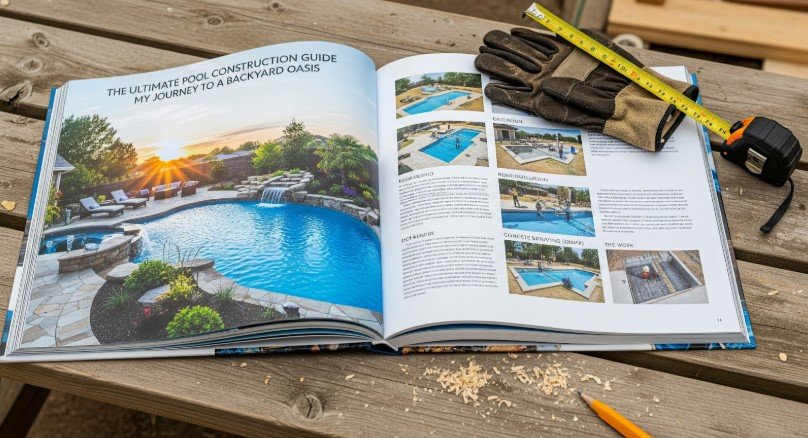
I’ll never forget the day we decided to do it. We were sitting on our back patio on a hot Central Ohio afternoon, the air thick with humidity, dreaming, as we often did, about having our own pool. For years, it felt like a distant fantasy, a luxury reserved for other people. The whole idea of building a pool seemed massive, mysterious, and overwhelming. Where would we even start? The sheer number of choices, the unknown costs, the horror stories you hear about projects gone wrong—it was enough to keep that dream firmly on the shelf.
Fast forward to today, and I’m writing this from that same patio, but now it overlooks a sparkling blue oasis that has completely transformed our home and our lives. The journey was an incredible learning experience, and I want to share it with you, in detail. This is more than just a pool construction guide; it’s the real, unfiltered story of our project, filled with all the tips, insights, and lessons I wish I had from the beginning.
From the initial pool design sketches on a napkin to navigating the bureaucracy of permits for a pool, from understanding the complex construction process to finally creating the perfect outdoor living space, I’m going to walk you through every single step. If you’re standing where I was, dreaming of a pool but intimidated by the process, this is for you.
Phase 1: Planning and Dreaming (The Most Important Step!)

Before you can move a single shovelful of dirt, you have to do the mental heavy lifting. This initial phase is all about deep thinking, meticulous research, and honest budgeting for your pool. Rushing this step is the single biggest mistake you can make. A well-planned pool is a joy forever; a rushed pool can be a source of constant regret.
Defining Your “Why” and Mastering Your Pool Design
First, we had to answer a simple question: why do we want a pool? And the answer couldn’t just be “because it’s hot.” We had to envision our future life with the pool. Was it primarily for the kids to splash and burn off energy? Was it for me to swim laps for exercise? Was it a social hub for entertaining friends and family on weekends?
For us, it was a mix of all three, and this realization became the bedrock of our pool design.
- For the kids (and us lazy adults): We became obsessed with the idea of a “tanning ledge,” also called a Baja shelf. It’s a large, shallow area, usually 6 to 12 inches deep, perfect for little ones to splash safely or for us to place a couple of lounge chairs right in the water. We designed ours to be large enough for two chairs and a small table. It’s now the most used part of the entire pool.
- For exercise: This led to a debate: a curvy, lagoon-style pool or a classic rectangle? While freeform shapes look natural and beautiful, they are terrible for swimming laps. We compromised by choosing a “geometric” shape—mostly rectangular but with some interesting angles and offset steps to keep it from looking like a simple box. This gave us a long, uninterrupted lane for swimming.
- For entertaining: We knew the steps and benches would be social gathering spots. Instead of small, cramped steps, we designed wide, grand steps on one end that serve as extra seating. We also included a long bench along one of the walls in the deep end, which is perfect for adults to hang out and chat while still being in the water.
Thinking through the function first is the key to a successful pool design. Don’t just pick a shape you like; design it around your life.
The Elephant in the Yard: Budgeting for a Pool
Let’s talk money. A pool is a major home improvement project, and the number a salesperson gives you for the “pool” is often just the starting point. Our initial research showed us that a safe bet was to take the cost of the pool itself and add 50-100% on top of that for everything else. It sounds scary, but it’s realistic.
Here’s a more granular checklist we created for budgeting for a pool, which proved to be incredibly accurate:
- The Pool Shell & Installation (50-60% of total cost): The core cost of the pool structure, labor, and basic equipment package (pump, filter).
- Pool Decking / Patio (15-25%): This is a huge and often underestimated cost! The area around the pool is just as important. Pavers, stamped concrete, and wood all have vastly different price points. We budgeted for at least 4 feet of patio around the entire pool, with a larger 15×20 foot area for dining and lounging.
- Fencing & Safety (5-10%): In Ohio, safety fencing isn’t optional, it’s the law. The cost of aluminum, vinyl, or wood fencing can add thousands to the project. Don’t forget self-closing, self-latching gates.
- Electrical Work (3-5%): A licensed electrician has to run a dedicated sub-panel and bond all the metal components. This is not a DIY job.
- Landscaping & Restoration (3-8%): Heavy equipment will destroy your lawn. You’ll need to budget for new sod, plants, mulch, and potentially a sprinkler system repair. This is a key part of landscaping around the pool.
- Upgrades & Features (5-15%): This is the “fun stuff” category. A heater, saltwater system, automatic cover, water features, or fancy LED lighting all add to the cost.
- Permits & Fees (1-2%): Your municipality will have fees for the permits for your pool.
- Contingency Fund (10%): Set aside at least 10% of your total estimated cost. Trust me, you will use it. We hit an unexpected patch of rock during excavation that required a hydraulic hammer, costing us an extra day of labor and equipment rental. Our contingency fund saved the day.
Creating this detailed budget wasn’t just about numbers; it was about making informed choices. It helped us decide where to splurge (on an energy-efficient pump that will save us money long-term) and where to save (by opting for standard concrete for the patio initially, with plans to upgrade later).
Choosing a Contractor: The Most Critical Decision
I can’t state this strongly enough: choosing a contractor is the single most important decision you will make in this entire process. A great contractor is a partner, a guide, and a problem-solver. A bad one can turn your dream into a financial and emotional nightmare.
We interviewed three highly-rated local companies. Here’s the detailed checklist of questions we used to vet them:
- Business History: How long have you been in business under this name? Are you fully licensed and insured in Ohio (ask to see the documents!)?
- Process & Timeline: Can you provide a detailed, step-by-step timeline for the entire construction process? How do you handle weather delays?
- Who is on my property?: Do you use your own employees or do you subcontract the work (excavation, electrical, plumbing)? If you use subs, are they as insured as you are?
- Transparency in Quoting: Will you provide a detailed, itemized quote that breaks down the cost of the pool, equipment, electrical, etc.? What is NOT included in this quote? (This is a huge one!)
- References: Can I have the names and numbers of your last three customers? (Not their best three, their last three). We also asked if we could visit a pool they were currently building to see a live job site.
- Communication: Who will be my single point of contact throughout the project? How will we communicate (text, email, app)?
The contractor we chose wasn’t the cheapest. They were about 5% more expensive than the middle-ground quote. But they won us over with their incredible transparency and communication. They gave us a 20-page document that outlined every single step, and they spent two hours on our initial call just educating us. We felt like we were hiring a partner, not a salesperson.
Phase 2: Permits, Materials, and Making it Official
With a solid plan and a trusted contractor, it was time to move from dreaming to doing.
The Paper Chase: Getting Permits for a Pool
Our contractor handled the entire permitting process, and it was worth its weight in gold. They knew the specific setback requirements for our township, the exact specifications for fence height and gate latches, and the standards for electrical bonding that the inspectors would be looking for. Getting the permits for a pool is a crucial step that ensures your pool is built safely and to code, which is vital for your insurance and the resale value of your home.
Decoding Pool Materials: A Deep Dive
This was our next big decision. We had friends with all three types of in-ground pools, so we had some second-hand knowledge.
- Concrete (Gunite): This is the traditional, old-school method.
- The Appeal: Ultimate design freedom. If you can dream it, you can build it. It’s a fortress in the ground.
- The Reality: The construction process is long and messy (often 3-6 months). The surface is rough (like sandpaper), which can be tough on kids’ feet. The porous surface also uses more chemicals and electricity to maintain, and you have to budget for a costly acid wash every 3-5 years and a complete resurfacing every 10-15 years.
- Vinyl Liner: This is a very popular option, especially in the Midwest.
- The Appeal: Lowest initial cost for building a pool. The shape and size are still highly customizable. The liner surface is smooth and comfortable.
- The Reality: The liner is the pool’s weak point. While durable, it can be punctured. The biggest factor is that the liner must be replaced every 7-12 years, a significant recurring cost ($5,000-$8,000+).
- Fiberglass: This is a one-piece, pre-fabricated shell.
- The Appeal: The fastest installation by far. The gelcoat surface is non-porous, making it incredibly low-maintenance and resistant to algae. The structure is exceptionally strong yet flexible, ideal for Ohio’s freeze-thaw cycles.
- The Reality: You are limited to the shapes and sizes offered by the manufacturer. The initial cost can be higher than vinyl.
We chose fiberglass. For our family, the promise of a super-fast installation and the long-term benefit of minimal maintenance outweighed the limitation on custom shapes. We found a geometric design from our contractor’s catalog that we absolutely loved, and the idea of spending our weekends swimming instead of scrubbing was the ultimate deciding factor.
Phase 3: The Construction Process Unveiled
This is where the real excitement begins. Watching your vision physically take shape in your backyard is a surreal experience.
- The Layout & The Dig: The crew arrived and painted a giant outline of our pool on the grass. Suddenly, it felt real. The next day, the excavator showed up. The skill of the operator was incredible to watch, carving our pool out of the earth with precision. In one day, our flat lawn became a massive, perfectly shaped hole.
- Setting the Foundation & Pool Delivery: A layer of clean gravel was carefully laid and leveled at the bottom of the hole, forming the bed for the pool. Then came the big day: the pool arrived on a massive flatbed truck. A crane hoisted the shimmering blue shell high into the air, over our house, and lowered it gently into place. It was a breathtaking sight.
- The Technical Stuff: Plumbing, Electrical, and Backfilling: This phase looked like organized chaos. A web of PVC pipes was laid and connected for the skimmers, drains, and returns. The electricians ran conduit and bonded all the metal components. As these connections were made, the crew began backfilling the gap around the pool with gravel, while simultaneously filling the pool with water from tanker trucks. This equalization of pressure is a critical step.
- The Hardscape: Forming the Patio: Once the pool was in and the ground had settled, the masonry crew began their work. They formed up the perimeter and poured the concrete bond beam that locks the pool shell into the patio. Then they laid the rebar and poured the main patio deck. This took about a week and was the final piece that connected the pool to the rest of the yard.
Phase 4: Creating the Complete Outdoor Living Space
The pool is the star, but the surrounding environment is what makes it a true oasis. Our goal was to create a complete outdoor living space that felt like an extension of our home.
Landscaping Around the Pool
Strategic landscaping around the pool is essential. It provides beauty, privacy, and helps keep the pool clean.
- What to Plant: We chose a mix of ornamental grasses (like Karl Foerster), boxwoods for structure, and flowering perennials like lavender and daylilies that are hardy and relatively low-mess.
- What to Avoid: Steer clear of messy trees (like cottonwoods or trees that drop a lot of small flowers), plants with thorns, and anything that attracts a lot of bees right next to the patio. We also made sure to create a barrier of mulch and river rock between the lawn and the patio to prevent grass clippings from blowing into the pool.
Creating “Zones” for Living
We thought of our patio not as one big space, but as different outdoor “rooms.”
- The Dining Zone: An area closest to the house with a large table and chairs under a cantilever umbrella.
- The Lounging Zone: The main area next to the pool with comfortable chaise lounges for sunbathing.
- The Conversation Zone: We added a small fire pit with four comfortable chairs a little further away from the main action. It’s the perfect spot to relax on cooler evenings and extends the use of our outdoor living space into the spring and fall.
Phase 5: Life as a Pool Owner & Essential Pool Maintenance Tips
The construction is over, but your role as a pool owner is just beginning. The good news is that modern pools are much easier to care for than you might think. Here are my top pool maintenance tips.
- The Weekly Checklist:
- Test and Balance: Test the water for pH, alkalinity, and sanitizer levels. Adjust with chemicals as needed. It takes 5 minutes once you get the hang of it.
- Skim and Empty: Skim any floating debris off the surface and empty the skimmer and pump baskets.
- Brush and Clean: We invested in a robotic pool cleaner (worth every penny!), but we still brush the steps and benches once a week.
- The Monthly Checklist:
- Clean the Filter: Backwash your sand/DE filter or clean your cartridge filter to keep the water circulating efficiently.
- Check Equipment: Take a look at your pump and equipment for any leaks or unusual noises.
Consistency is everything. A little bit of regular attention is far better than letting things go and having to deal with a big, expensive problem like an algae bloom.
Was It Worth It?
I get asked this question all the time. My answer, without a single hesitation, is yes. A thousand times, yes. The process of building a pool was a major undertaking, an education in construction, budgeting, and patience. But every decision, every dollar spent, every moment of temporary disruption has paid off tenfold.
Our backyard has been transformed from a simple patch of grass into the vibrant heart of our home. It’s the place we gather, celebrate, relax, and connect. This pool construction guide is the story of our project, but I hope it serves as a roadmap for yours. It’s a big journey, but with careful planning, a realistic budget, and the right contractor, that backyard dream can absolutely become your beautiful reality.
